Key takeaways
- Max Planck discovered that the energy of radiating heat behaves as if it comes in small, equal packets. He announced it in Berlin on 14 December 1900, together with the constant that sets their size, now called the Planck constant, h.
- His own first value was h = 6.55 × 10⁻²⁷ erg seconds. Since the SI revision agreed in November 2018, h is fixed at exactly 6.62607015 × 10⁻³⁴ joule seconds, so his 1900 number was about 1 percent low.
- There is no Max Planck atomic model. His 1900 papers are about idealised oscillators he called resonators. The atom model built on his constant is Niels Bohr’s, published in 1913.
- The same calculation gave him the Boltzmann constant, the number of molecules in a mole and the charge of the electron, close to the best values measured later.
- He won the 1918 Nobel Prize in Physics “by his discovery of energy quanta”. The prize was awarded in 1919 and he gave his lecture on 2 June 1920.
On 14 December 1900, Max Planck stood up at a meeting of the German Physical Society in Berlin and read a short paper. In it he treated the energy of radiating heat as a whole number of “finite equal parts”, each one equal to a new constant times a frequency (Verhandlungen 2, pp. 237 to 239). That constant is h, and the idea is the quantum. This is what Max Planck discovered. He was 42, and he was not sure the packets were real.
The short version, then. Planck found the correct law for how a hot body shines at each colour, and to explain it he had to break energy into steps. Everything else people connect with his name, from the atomic model searchers ask about to light particles, was built by other physicists on that one step. This article dates each part against Planck’s own papers and his Nobel lecture. Our longer essay on Planck’s impact on quantum physics follows what happened next.
The problem Planck was trying to solve
Heat a lump of iron and it glows red, then orange, then white. Physicists in the 1890s wanted one formula that gave the brightness of that glow at every wavelength for any temperature. The cleanest case was a “black body”, an ideal object that absorbs everything that falls on it. In practice it was a hot cavity with a small hole.
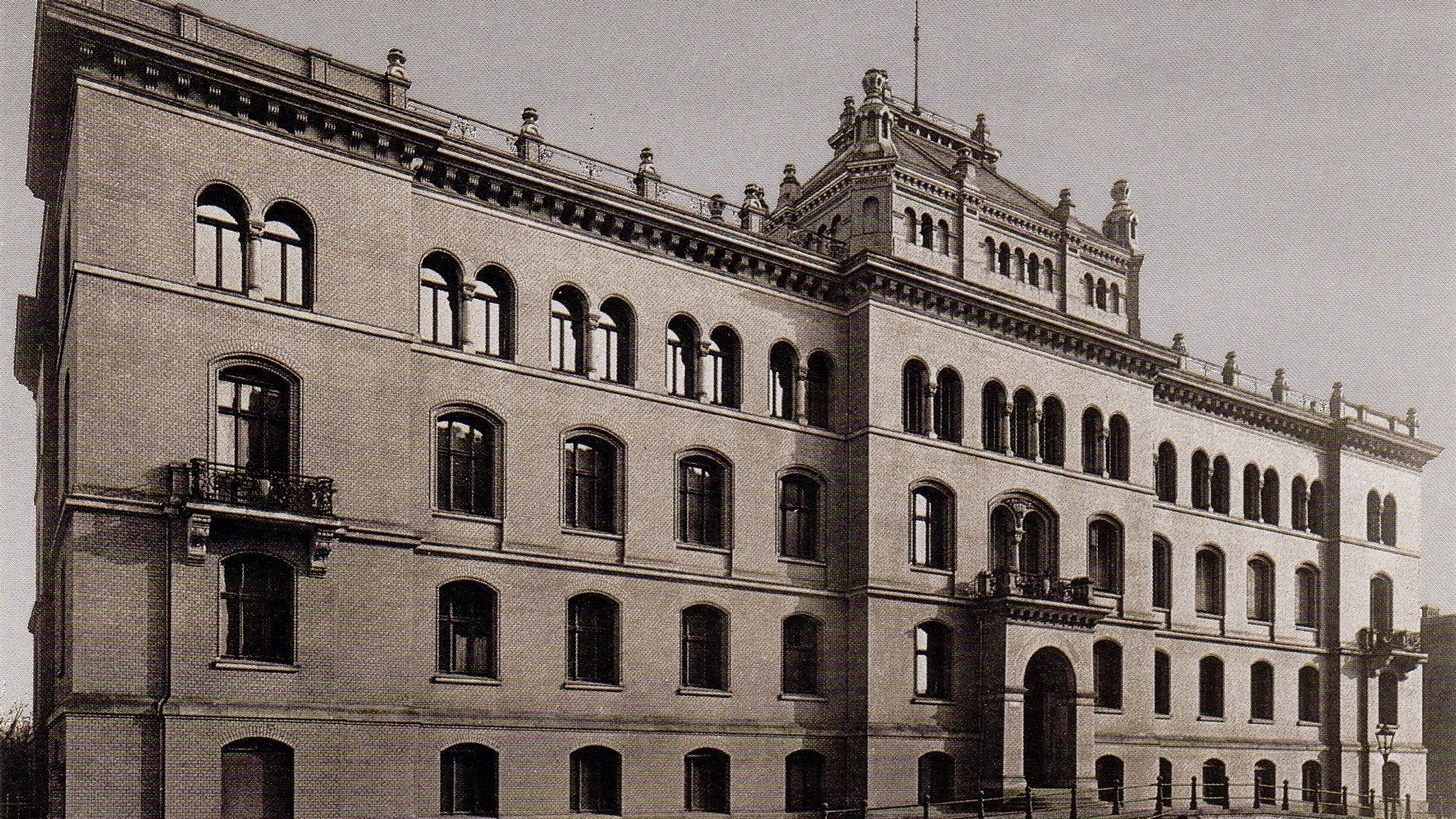
Wilhelm Wien had a formula, and in 1899 it was, in Planck’s words, at the “foreground of interest” (Nobel lecture). Then the measurements began to disagree with it at long wavelengths. Some were made by Otto Lummer and Ernst Pringsheim at what Planck called “the State Institution in Charlottenburg”, the Physikalisch-Technische Reichsanstalt, shown above, where Lummer worked from 1887 to 1904 (Neue Deutsche Biographie). Planck named who found the gap: “first by O. Lummer and E. Pringsheim, and finally by H. Rubens and F. Kurlbaum”. The last pair measured the infrared rays left after light bounces repeatedly off fluorite and rock salt crystals. Wien’s law, Planck wrote in 1901, had “keine allgemeine Gültigkeit”, no general validity (Annalen der Physik 4, p. 553).
The failure was in the infrared. The phrase “ultraviolet catastrophe”, often attached to this story, came later and from Paul Ehrenfest, as the physicist Luis Boya notes in his history of the formula (Boya, 2004). In June 1900 Lord Rayleigh had pointed out that classical physics gives each oscillator the same average energy, kT. Only by 1905 was it clear that this makes the radiation grow without limit at short wavelengths. Planck was not working from that result.
19 October 1900: a formula that fitted
The Berlin experimenters and Planck met at the same meeting on 19 October 1900. Kurlbaum reported the new infrared results obtained with Rubens, and Planck presented a short note titled “Ueber eine Verbesserung der Wienschen Spektralgleichung”, on an improvement of Wien’s spectral equation (transcription of the talk). His new formula matched the measurements at short and long wavelengths alike.
He knew why it worked only in a narrow sense. Twenty years later he called it “a happily chosen interpolation formula” (Nobel lecture), a guess that joined two limits smoothly. So he set out to derive it from physics. That took “some weeks of the most strenuous work of my life”, he said, until “light came into the darkness”.
14 December 1900: energy in equal parts
The derivation he read on 14 December borrowed a counting method from Ludwig Boltzmann. To count the ways energy could be shared among his resonators, Planck had to cut the energy E into pieces. He wrote of E “als zusammengesetzt aus einer ganz bestimmten Anzahl endlicher gleicher Teile”, made of a definite number of finite equal parts. He called this “der wesentlichste Punkt der ganzen Berechnung”, the most essential point of the whole calculation (Verhandlungen 2, p. 239).
Each part, the energy element, was h times the frequency of the resonator. In the full paper received by the Annalen der Physik on 7 January 1901, he wrote that the energy has to be treated as a discrete quantity, “nicht als eine stetige, unbeschränkt teilbare”, not a continuous one that can be divided without limit (Annalen der Physik 4, p. 556). That is the whole quantum idea in one clause.
He did not like it. In a letter to the physicist Robert Wood dated 7 October 1931, as quoted by the historians Nadia Robotti and Massimiliano Badino, Planck called the episode “an act of desperation”. He had needed a theoretical explanation “at any cost” (Robotti and Badino, Annals of Science, 2001, p. 138). In his Nobel lecture he recalled the choice he had faced: either the quantum was “a fictional quantity” or it played a fundamental role. By 1920, he said, “experiment has decided for the second alternative”.
What the calculation gave him
From the radiation data the 14 December paper derived two constants, h and k. From them Planck computed the mass of atoms, the number of molecules in a gram-molecule and the charge of the electron. Four of those numbers are in the table. His Nobel lecture calls the agreement on the charge the “decisive confirmation of the usefulness of my theory”.
| Quantity | Planck, 14 Dec 1900 | Value today | Record |
|---|---|---|---|
| Planck constant h | 6.55 × 10⁻²⁷ erg s | 6.62607015 × 10⁻²⁷ erg s (exact; 6.62607015 × 10⁻³⁴ J s) | Verh. 2, p. 239; NIST |
| Boltzmann constant k | 1.346 × 10⁻¹⁶ erg per degree | 1.380649 × 10⁻¹⁶ erg per kelvin (exact) | Verh. 2, p. 241; BIPM |
| Molecules per gram-molecule | 6.175 × 10²³ | 6.02214076 × 10²³ per mole (exact) | Verh. 2, p. 244; BIPM |
| Elementary charge e | 4.69 × 10⁻¹⁰ esu | 4.65 × 10⁻¹⁰ esu counted by Rutherford and Geiger, as Planck reported in 1920 | Verh. 2, p. 245; Nobel lecture |
His h was about 1.1 percent below today’s value, and his k about 2.5 percent below (our arithmetic from the figures in the table). For numbers pulled out of a few curves of glowing cavities in 1900, both are close. Since the revision of the SI agreed in November 2018, h and k are no longer measured at all: they are fixed by definition, and the kilogram is defined from h (BIPM). Our list of five physical constants that govern the universe puts h in its company.
Get the next one by email
One new article a week on radiation, particles and the instruments that measure them, with its sources. No spam, unsubscribe any time.
Was there a Max Planck atomic model?
No. Many people search for one, and it does not exist. Planck’s 1900 and 1901 papers describe “Resonatoren”, idealised vibrating systems in equilibrium with radiation. The word Atom does not appear in the 1901 Annalen paper, and the 1900 talk mentions atoms mainly in its closing section, where he converts his constants into molecular quantities (Annalen 4, Verhandlungen 2).
The atomic model that used his constant came from Niels Bohr in July 1913. Bohr wrote that “it seems necessary to introduce” what he called “Planck’s constant, or as it often is called the elementary quantum of action” to explain the hydrogen atom and its spectrum (Bohr, Philosophical Magazine 26, 1913). Planck gave the credit the same way. In 1920 he said the quantum idea drew “its greatest support” from “the atom theory by Niels Bohr” (Nobel lecture). The argument that followed between Bohr and Einstein is told in Einstein vs Bohr.
What Einstein added in 1905
Planck had quantised the energy of the oscillators that emit light. Albert Einstein went further and quantised light itself. In his 1905 paper in Annalen der Physik 17 he proposed that light “consists of a finite number of energy quanta that are spatially localized at points of space” (Wikisource translation). One section of that paper rederives Planck’s constants from Planck’s own formula.
Planck did not accept light quanta for years (Boya), and his Nobel lecture lists Einstein as the first to take energy quanta into new areas. Einstein’s Nobel came for the photoelectric law from that paper, and his patents are a separate story told in what Einstein invented. For the later sequence of discoveries, see the ten discoveries that changed quantum physics.
Max Planck’s discovery, dated
| Date | What happened | Record |
|---|---|---|
| 23 April 1858 | Planck born in Kiel | Nobel Prize facts |
| 19 October 1900 | Kurlbaum reports the infrared results with Rubens; Planck presents his improved radiation formula at the same meeting | Talk transcription |
| 14 December 1900 | Planck splits energy into finite equal parts with h = 6.55 × 10⁻²⁷ erg s | Verhandlungen 2, p. 237 |
| 7 January 1901 | Full paper received by Annalen der Physik; same h and k | Annalen 4, p. 563 |
| 1905 | Einstein proposes that light itself comes in energy quanta | Annalen 17, p. 132 |
| July 1913 | Bohr’s model of the hydrogen atom uses “Planck’s constant” | Phil. Mag. 26, p. 1 |
| 1919 | The 1918 Nobel Prize in Physics is awarded to Planck | nobelprize.org |
| 2 June 1920 | Nobel lecture: The Genesis and Present State of Development of the Quantum Theory | nobelprize.org |
| 1930 to 1937 | President of the Kaiser Wilhelm Society | Max Planck Society |
| 23 January 1945 | His son Erwin is executed after the 20 July plot against Hitler | Max Planck Society; MPG essay |
| 4 October 1947 | Planck dies in Göttingen | Nobel Prize facts |
The Nobel Prize and the name
The Nobel committee found no 1918 nomination that met its criteria, so it held the physics prize back for a year. It awarded the 1918 prize to Planck in 1919, “in recognition of the services he rendered to the advancement of Physics by his discovery of energy quanta” (nobelprize.org). The Max Planck Society’s own timeline says he received it in 1920, the year he gave the lecture in Stockholm (MPG).
From 1930 to 1937 Planck led the Kaiser Wilhelm Society, taking the post at 72 (MPG). In January 1945 his son Erwin, involved in the 20 July plot, was executed. Planck died in Göttingen on 4 October 1947.
References
- Max Planck, “Zur Theorie des Gesetzes der Energieverteilung im Normalspectrum”, Verhandlungen der Deutschen Physikalischen Gesellschaft 2, 237 (talk of 14 December 1900)
- Max Planck, “Ueber das Gesetz der Energieverteilung im Normalspectrum”, Annalen der Physik 4, 553 (1901)
- Max Planck, “Ueber eine Verbesserung der Wienschen Spektralgleichung”, talk of 19 October 1900, transcription (Lernhelfer)
- Max Planck, Nobel Lecture, 2 June 1920: The Genesis and Present State of Development of the Quantum Theory
- The Nobel Prize in Physics 1918, summary, nobelprize.org
- Max Planck, facts, nobelprize.org
- Max Planck Society, Max Planck: biographical overview
- Lorenz Friedrich Beck, Max Planck and the Kaiser Wilhelm Society, Max Planck Society
- Nadia Robotti and Massimiliano Badino, “Max Planck and the Constants of Nature”, Annals of Science 58 (2001), 137 to 162
- Albert Einstein, “On a Heuristic Point of View about the Creation and Conversion of Light”, Annalen der Physik 17 (1905), Wikisource translation
- Niels Bohr, “On the Constitution of Atoms and Molecules”, Philosophical Magazine 26 (1913), Project Gutenberg
- NIST, CODATA value of the Planck constant
- BIPM, The SI defining constants
- Neue Deutsche Biographie, Lummer, Otto
- Luis J. Boya, “The Thermal Radiation Formula of Planck (1900)”, arXiv physics/0402064
Cite this article
Turner, A. (2026, November 7). What Did Max Planck Discover? The Quantum, Dated. ScienceShot. https://scienceshot.com/post/what-did-max-planck-discover
Turner, Alex. “What Did Max Planck Discover? The Quantum, Dated.” ScienceShot, 7 Nov. 2026, scienceshot.com/post/what-did-max-planck-discover.
Turner, Alex. “What Did Max Planck Discover? The Quantum, Dated.” ScienceShot, November 7, 2026. https://scienceshot.com/post/what-did-max-planck-discover.
@online{scienceshot-what-did-max-planck-2026,
  author       = {Turner, Alex},
  title        = {{What Did Max Planck Discover? The Quantum, Dated}},
  organization = {ScienceShot},
  date         = {2026-11-07},
  year         = {2026},
  url          = {https://scienceshot.com/post/what-did-max-planck-discover}
}
https://scienceshot.com/post/what-did-max-planck-discover
Get one article a week
One new article a week on radiation, particles and the instruments that measure them, with its sources. No spam, unsubscribe any time.