Key takeaways
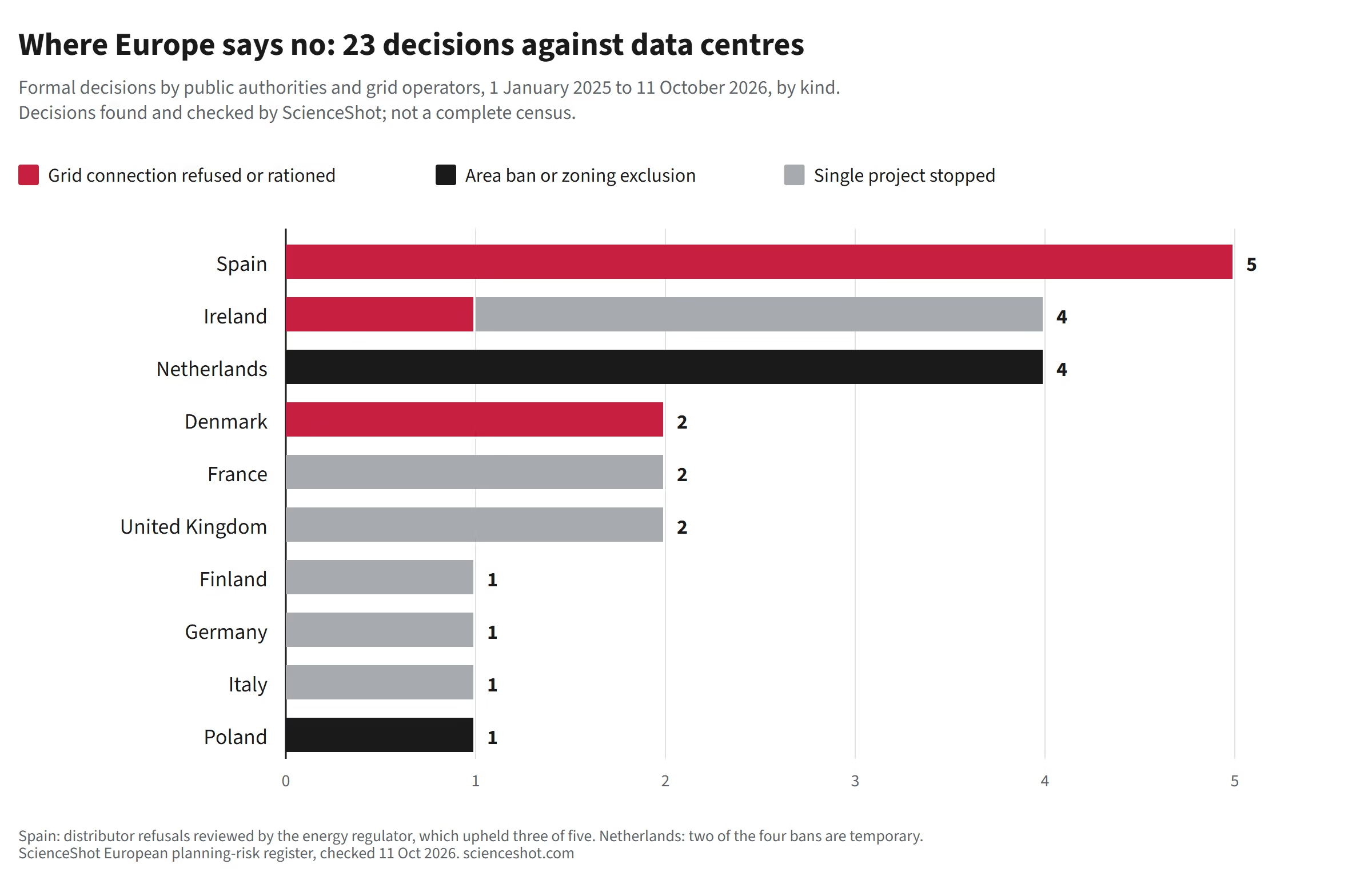
- We found and checked 23 formal decisions in ten European countries, between 1 January 2025 and 11 October 2026, that stopped, banned or rationed data centres: 10 single projects stopped, 5 bans or exclusions in zoning plans, and 8 grid refusals or rationing rules.
- Three of the grid decisions cover a whole country. Ireland’s energy regulator now attaches conditions to new data-centre connections of 1 MVA or more, Denmark’s transmission operator paused new connection agreements in March 2026, and a Danish emergency law that took effect on 12 October 2026 is expected to put data centres last in the queue unless they serve a critical function.
- Four Dutch municipalities wrote bans into their zoning plans. Zaanstad bars new data centres above 2,000 m² and 5 MVA, and Amsterdam does so in principle; Heusden and Oldambt have temporary bans while they write new rules.
- Many refusals are not final. Edinburgh’s is under appeal to Scottish Ministers, both French cases rest on interim court orders, and Spain’s energy regulator overturned or partly overturned two of five distributor refusals.
- In our reading, a site search in Europe should test the grid connection and the zoning plan before the planning committee: those are where the widest-reaching decisions sit.
Twenty-three. That is how many formal decisions against data centres we found and could check in Europe between 1 January 2025 and 11 October 2026. Each was taken by a council, a court, an appeals board, a regulator, a parliament or a grid operator. Each refused a project, banned data centres from an area, or refused or rationed their grid connection.
The count is not a census. It covers decisions we could confirm against public records; local decisions in smaller places are surely missing. But the pattern is already clear, and it differs from the one in the United States, where local opposition to single projects is the story. In Europe the decisions that reach furthest are written into grid rules and zoning plans. Many refusals of single projects are still open to appeal.
The register: 23 decisions
One row per decision, newest status as of 11 October 2026. A grid row is a refused connection or a rule that rations connections; a project row is a decision that stopped a named scheme; an area row is a ban or exclusion in a zoning plan.
| Country | Place | Decided by | What was decided | Date | Status on 11 Oct 2026 |
|---|---|---|---|---|---|
| Spain | León | Distributor I-DE; reviewed by the energy regulator CNMC | 15 MW connection refused: no demand capacity at the substation | 13 Jan 2025 | Refusal upheld by the regulator, 24 Apr 2025 |
| Spain | San Sebastián | Distributor I-DE; reviewed by CNMC | 30 MW connection refused: the substation would be overloaded if a transformer failed | 27 Jan 2025 | Upheld, 27 Jun 2025; the distributor was told to name a viable connection point above 36 kV |
| Spain | Meco (Madrid) | Distributor I-DE; reviewed by CNMC | 10 MW connection refused: no distribution capacity | 7 Apr 2025 | Upheld, 12 Feb 2026 |
| Spain | Valle de Elorz (Navarra) | Distributor I-DE; reviewed by CNMC | 50 MW connection at 66 kV refused | 3 Nov 2025 | Partly overturned, 26 May 2026: 5 MW of firm capacity to be offered |
| Spain | Madrid (Sanchinarro and Fuencarral) | Distributor I-DE; reviewed by CNMC | Six data-centre requests, 79.4 MW in total, refused | 11 Feb 2026 | Overturned, 25 Jun 2026; a study of each request ordered |
| Ireland | Whole country | Commission for Regulation of Utilities | New data-centre connections of 1 MVA or more made conditional: from 10 MVA, dispatchable generation or storage on site or nearby; from 1 to 10 MVA, an autoproducer unit; at least 80% of annual demand from additional Irish renewables within six years | 12 Dec 2025 | Policy decided; earlier applications stay under the old policy |
| Ireland | Clondalkin, South Dublin | An Bord Pleanála (appeals board) | Equinix: changes to a permitted data centre, including ten gas-fired generators, refused | 19 Feb 2025 | Stands |
| Ireland | Clondalkin, South Dublin | An Bord Pleanála | Vantage data centre refused, overruling its own inspector; no fixed grid connection agreement | 4 Apr 2025 | Stands |
| Ireland | Killala, Co. Mayo | An Coimisiún Pleanála (appeals board) | Mayo Data Hub campus refused on a third-party appeal, overturning the county council’s grant; no fixed grid connection shown | Sep 2026 | Stands |
| Netherlands | Amsterdam | City council | Zoning plan bars, in principle, new or expanded data centres above 2,000 m² and 5 MVA | Jun 2025 | In force |
| Netherlands | Zaanstad | Municipal council | Permanent zoning change with the same thresholds | 12 May 2026 | In force since about mid-July 2026 |
| Netherlands | Heusden | Municipal council | Temporary ban on new data centres across the municipality, for up to 18 months | 26 May 2026 | In force since 27 May 2026 |
| Netherlands | Oldambt | Municipal executive | Temporary ban on new data centres on business parcels | 23 Jun 2026 | In force since 2 Jul 2026 |
| Denmark | Whole country | Energinet (transmission operator) | Pause on new grid connection agreements; about 60 GW of new demand was queued against a national peak of about 7 GW | 2 Mar 2026 | Stricter queue rules from 3 Jun; new agreements for large transmission customers expected in the autumn, no date given |
| Denmark | Whole country | Parliament | Emergency grid law with four priority categories; data centres expected in the lowest unless tied to a critical function, and grid companies may refuse them | Early Oct 2026 | Adopted; in force from 12 Oct 2026 |
| United Kingdom | Edinburgh | City council planning committee | Data centre of about 210 MW (permission in principle) refused on climate grounds, against officer advice | 4 Feb 2026 | Appeal taken over by Scottish Ministers; decision pending |
| United Kingdom | Amlwch, Anglesey | County council | Data centre on the former Octel site refused: not enough information on landscape, ecology and other matters | 20 Apr 2026 | No appeal found |
| France | Le Bourget | Mayor | Segro building permit withdrawn: the building exceeds the 23 m height limit | 12 Jun 2026 | Court refused to suspend the withdrawal, 28 Jul; main case pending |
| France | Alixan (Drôme) | Administrative court, interim judge | Sesterce AI computing centre permit (40 MW first phase) suspended: no prior impact study | 10 Jul 2026 | Developer has appealed to the Conseil d’État |
| Finland | Pyhäjoki | Municipal board | Zoning initiative for the Enetron Park data-centre and energy campus rejected, 5 votes to 2 | Late Sep 2026 | Developer says it was disappointed and will review the decision |
| Germany | Groß-Gerau | Town council | Vote of 18 to 14 not to negotiate development contracts for a 174 MW Vantage campus | 3 Feb 2026 | Council vote stands; Vantage reviewing next steps |
| Italy | Cologno Monzese | Municipal executive (giunta) | Plan for an 80 MW data centre rejected: not fully compliant with the town plan; water, energy and noise cited | Late Sep 2026 | Stands |
| Poland | Dobre | Municipal council | Zone for a data centre on about 90 ha struck from the draft general plan | Late Aug 2026 | Stands |
The grid says no to whole countries
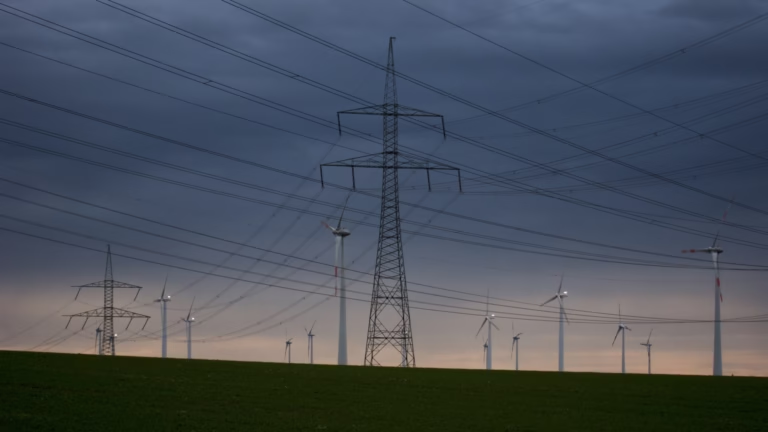
Eight of the 23 decisions are about the grid, and three of them apply nationally. In Ireland the energy regulator decided on 12 December 2025 that a new data centre connecting at 10 MVA or more must bring dispatchable generation or storage on site or nearby; from 1 to 10 MVA it needs an autoproducer unit. Within six years of connection it must also cover at least 80% of its annual demand with additional renewable electricity generated in Ireland. Applications made before that date stay under the old policy. Grid supply runs through all three Irish appeal refusals in the register: two turned on the absence of a fixed grid connection agreement, the third on a plan for ten gas-fired generators.
In Denmark the transmission operator Energinet paused new connection agreements on 2 March 2026, with about 60 GW of new demand queued against a national peak of about 7 GW. The queue included data centres, batteries and Power-to-X plants. Stricter queue rules followed in June, and Parliament then adopted an emergency grid law that took effect on 12 October 2026. It sorts new connections into four priority categories. Data centres are expected to land in the lowest unless they serve a critical function. Grid companies may refuse requests in the lower categories when capacity runs short.
Spain shows the same constraint one level down. Five times in our window the distributor I-DE refused a data-centre connection, mostly for lack of capacity, from 10 MW in Meco to six requests totalling 79.4 MW in Madrid. Each developer took the refusal to the energy regulator CNMC. It upheld three. In Navarra it partly overturned the refusal and ordered an offer of 5 MW of firm capacity against 50 MW requested. In Madrid it overturned the refusals and ordered a study of each request. The appeal route works, but its best outcome so far is a fraction of the capacity asked for, or a new study.
Our European grid connection tracker follows these connection rules country by country.
Get the next one by email
Power, cooling, chips and the rules that shape them. No spam, unsubscribe any time.
The Netherlands writes bans into zoning plans
All four Dutch decisions are area rules, not refusals of a single project. Amsterdam’s council adopted a zoning plan in June 2025 that in principle bars new or expanded data centres above 2,000 m² of floor area and 5 MVA of connection capacity. Applications made, or pre-application talks begun, before 28 December 2023 are still considered, under conditions. Zaanstad made the same thresholds permanent in its zoning plan on 12 May 2026. Heusden and Oldambt took temporary decisions in May and June 2026. Both ban new data centres while a new plan is written; Heusden’s runs for up to 18 months.
Poland’s single entry has the same shape. In late August 2026 the council of Dobre, east of Warsaw, struck a zone for a data centre of about 90 ha out of its draft general plan. No application was refused: the council removed the zone from the draft plan.
Single refusals: often not the last word
Ten decisions stopped a named scheme. Several are provisional. Edinburgh’s planning committee refused a data centre of about 210 MW on climate grounds in February 2026, against its officers’ advice. The developer appealed, and Scottish Ministers took over the appeal in August, so the final decision is theirs. In France, Le Bourget’s mayor withdrew a building permit for exceeding the local height limit, and a court refused to suspend the withdrawal while the main case continues. In Alixan, near Valence, an interim judge suspended the permit for an AI computing centre because no impact study had been done. The developer has appealed to the Conseil d’État.
Others look final. Ireland’s appeals board refused three schemes on grid grounds. Groß-Gerau’s town council voted 18 to 14 in February 2026 not to negotiate development contracts for a 174 MW campus. Vantage, which owns the plot, is reviewing its next steps. Cologno Monzese, north-east of Milan, rejected the plan for an 80 MW data centre in late September 2026. It found the plan not fully compliant with its town plan and cited water, energy and noise. Pyhäjoki in Finland rejected a zoning initiative for a data-centre and energy campus; the developer says it was disappointed and will review the decision. Anglesey refused a scheme on the former Octel site for lack of information.
What it means for site selection
The register suggests an order of questions for a developer choosing the next market. First, is there a connection, and on what terms? In Ireland and Denmark the answer is set nationally, and in Spain a distributor can refuse it at substation level. Second, does the zoning plan still allow a data centre? In four Dutch municipalities it no longer does above a modest size. Only then comes the planning vote on the project itself, and here an appeal may change the result.
The counter-trend is coming from Brussels. The European Commission’s proposed Cloud and AI Development Act would create acceleration zones with permit procedures capped at 12 months. It is a proposal, not law, and it cannot create grid capacity. Our regulation tracker follows it; the European project tracker lists the planned and permitted projects in these markets, and the market pages bring the grid, price and pipeline numbers together for each market.
Method and limits
What counts. A formal decision taken between 1 January 2025 and 11 October 2026 by a public authority, a court or a grid operator. It must refuse a data-centre project or its grid connection, ban or exclude data centres from an area, or ration their connection. Protests, motions without legal effect, statements by mayors, delays without a decision and proposals are excluded. So are withdrawals by applicants: four applications in Westland, in the Netherlands, were withdrawn after the municipality said it would not grant them, and are not counted. A negative regional opinion on a scheme near Milan is not counted because the procedure is not finished. Spain’s proposed hourly renewable-matching rule is a draft.
How it was checked. Every row was found in public records and checked again, field by field, by a second researcher. Rows were checked against published records and reporting on 11 October 2026; where an official order could not be read, the row follows reliable reporting. Some dates are known only to the month, and the exact day of two late-September decisions and of Dobre’s late-August vote is not confirmed. Capacity figures are as stated by the decision or the developer. They are not comparable across rows: some are connection requests, some campus figures.
What is missing. Coverage is thinner in central and eastern Europe, in Switzerland and Austria, and for municipal decisions in Spain and Germany. A missing country does not mean it had no refusals. We will update the register each quarter. For terms used, see the data-centre glossary.
Cite this: ScienceShot, Where Europe says no to data centres, October 2026, scienceshot.com, scienceshot.com/post/europe-data-centre-refusals-register-2026.
Cite this article
Turner, A. (2026, October 21). Where Europe says no to data centres: 23 decisions and who made them. ScienceShot. https://scienceshot.com/post/europe-data-centre-refusals-register-2026
Turner, Alex. “Where Europe says no to data centres: 23 decisions and who made them.” ScienceShot, 21 Oct. 2026, scienceshot.com/post/europe-data-centre-refusals-register-2026.
Turner, Alex. “Where Europe says no to data centres: 23 decisions and who made them.” ScienceShot, October 21, 2026. https://scienceshot.com/post/europe-data-centre-refusals-register-2026.
@online{scienceshot-europe-data-centre-refusals-2026,
  author       = {Turner, Alex},
  title        = {{Where Europe says no to data centres: 23 decisions and who made them}},
  organization = {ScienceShot},
  date         = {2026-10-21},
  year         = {2026},
  url          = {https://scienceshot.com/post/europe-data-centre-refusals-register-2026}
}
https://scienceshot.com/post/europe-data-centre-refusals-register-2026
Get the weekly brief
Sourced analysis of data-centre engineering and regulation, every Monday. No spam, unsubscribe any time.