Key takeaways
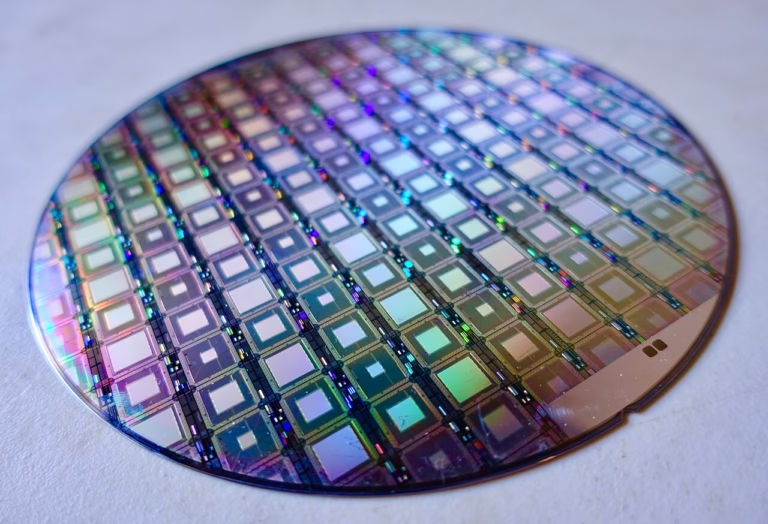
- Google’s Willow chip held a 101-qubit, distance-7 logical qubit at 0.143% ± 0.003% per error-correction cycle.
- Developed in the mid-1990s, the threshold theorem says logical errors shrink exponentially with code distance once physical errors fall below a threshold.
- Willow’s logical error rate dropped by a factor Λ = 2.14 ± 0.02 each time the code distance increased by two.
- The logical qubit’s effective lifetime beat the best physical qubit on the same chip by a factor of 2.4 ± 0.3, reaching beyond breakeven.
- Decoder speed at larger distances, and whether below-threshold behavior holds past a few hundred qubits, are the next milestones after Willow.
When Google announced that its Willow chip had crossed below the surface-code error threshold, most headlines treated it like a scoreboard update: bigger chip, better number, done. That framing skips the actual physics, and the physics is the interesting part. The quantum error correction threshold theorem isn’t a gradual improvement curve — it’s a hard mathematical dividing line that flips the entire logic of redundancy the instant you cross it.
Here’s the part I still find delightful after years around large redundant systems: everywhere else in engineering, adding more parts adds more ways to fail. Below the threshold, quantum error correction inverts that rule — piling on more physical qubits per logical qubit makes the system exponentially more reliable, not less. Cross above the threshold and the same redundancy makes things worse, with no gentle middle ground in between. Willow’s 101-qubit, distance-7 logical qubit landing at a 0.143% ± 0.003% error rate per cycle is what “below threshold” looks like; an earlier 17-qubit, distance-3 demonstration sitting near 3% is what “not there yet” looks like.
Redundancy Is Supposed to Get Harder, Not Easier
Think about how classical engineers handle failure. RAID arrays stripe data across multiple drives so one disk failure doesn’t lose data — but every extra drive is also one more component that can die, and rebuild windows get riskier as arrays grow. Jet engines carry triplicate-redundant sensors and backup hydraulic lines for the same reason, and CERN-style particle detectors use majority-voting logic across overlapping tracking layers to reject noise hits without ever being sure which single channel is lying. In every one of those systems, more parts means more coordination overhead and more independent chances for something to break.
Source: Google Quantum AI, “Quantum error correction below the surface code threshold,” Nature (Dec 9, 2024). d=7 measured (0.143% ± 0.003%); *d=3 and d=5 values derived from the measured suppression factor Λ = 2.14 ± 0.02 per +2 code distance.
Get the next one by email
Power, cooling, chips and the rules that shape them. No spam, unsubscribe any time.
The Quantum Error Correction Threshold Theorem
The threshold theorem, developed in the mid-1990s in the Aharonov–Ben-Or era, makes a precise claim: if the physical error rate per operation, p, sits below a critical value p_th — architecture-dependent, roughly 0.1–1% for superconducting surface codes — then encoding one logical qubit across a growing patch of physical qubits suppresses the logical error rate exponentially. The relationship scales roughly as (p/p_th) raised to the power (d+1)/2, where d is the code distance — the smallest number of physical qubit errors that can flip the encoded logical state without the decoder noticing, which is also why a distance-d code corrects up to (d−1)/2 arbitrary single-qubit errors. Cross above p_th and the exponent works against you instead — more physical qubits just means more independent chances to accumulate uncorrected errors faster than the decoder can catch them.
The surface code that Willow uses tiles qubits in a checkerboard of “data” qubits, which hold the encoded information, and “measure” qubits, which repeatedly extract parity (“syndrome”) information about their neighbors without ever directly measuring — and collapsing — the logical state itself. Those syndrome defects behave mathematically like the same exotic quasiparticles discussed in our piece on one-dimensional anyons: excitations that carry topological information rather than a simple on/off value. A classical decoder — Google runs a real-time, ML-assisted one — then reconstructs the most likely error pattern from the full history of syndrome measurements and corrects it in software, not by touching the fragile quantum state directly.
That decoding step is fundamentally a signal-versus-noise problem, the same kind of judgment call we wrote about when weighing a primordial black hole candidate against a noise fluctuation in gravitational-wave data. The decoder never sees the true error directly; it only sees a pattern of correlated hints and has to infer, statistically, what most likely happened. That’s structurally the same trick as the majority-voting logic in particle-detector electronics — a redundant, spatially overlapping consistency check — except the quantum version pays off exponentially instead of linearly, because independent error paths compound combinatorially as code distance grows.
Willow’s Below-Threshold Numbers vs. a Near-Threshold Chip
Google’s Nature paper reports two surface-code logical-qubit memories on Willow, at code distance 5 and distance 7. The distance-7 version used 101 physical qubits and held a logical error rate of just 0.143% ± 0.003% per error-correction cycle. Each time the code distance increased by two — from d=3 to d=5 to d=7 — the logical error rate dropped by a factor Λ = 2.14 ± 0.02, exponential suppression rather than a linear improvement from the added qubits.
That exponential curve is also why Willow is the first processor to cross what the field calls “beyond breakeven”: the logical qubit’s effective lifetime beat the best physical qubit on the same chip by a factor of 2.4 ± 0.3. Error correction, in other words, actually helped instead of adding net noise on top of what it was trying to fix — which is the whole point, and the part that’s genuinely hard to pull off. Compare that to an earlier repeated-QEC demonstration in the IBM/ETH Zurich lineage, which used a distance-3 surface code with 17 superconducting qubits and measured a logical error probability of roughly 3% per cycle — on par with, or slightly worse than, the best single physical qubit on that device.
That’s not a smaller version of the same win; it’s evidence of sitting on the wrong side of the threshold. Seventeen qubits arranged at distance 3 near p_th buys you almost nothing — you’re paying the coordination cost of redundancy without collecting the exponential reward. A hundred and one qubits arranged at distance 7, comfortably below p_th, buys you a logical qubit that outlives its own best component. Same idea, opposite regime, and the threshold theorem is the reason the two numbers aren’t on the same curve at all.
Source: Google Quantum AI, Nature (Dec 9, 2024) for the 101-qubit, d=7, 0.143% ± 0.003% result. IBM/ETH Zurich-lineage 17-qubit, d=3, ~3% figure is an illustrative approximate contrast aggregated from earlier repeated-QEC demonstrations, not a single precisely sourced value.
⚡ PHOTON’S TAKE
I’ve spent enough time around systems where redundancy is a tax — extra drives, extra sensors, extra committee meetings — that watching quantum error correction invert the rule still gives me a jolt. Below threshold, scale is a gift; above it, scale is a trap; there’s no boring middle where you get to coast. Willow’s 101 qubits beating a 17-qubit chip isn’t a bigger number winning — it’s a different physical regime entirely. Anyone still calling “below threshold” a marketing phrase hasn’t looked at the exponent.
Why the Quantum Error Correction Threshold Theorem Points Forward
The forward-looking question isn’t whether below-threshold error correction works — Willow already answered that — it’s whether it scales to the thousands of physical qubits a useful fault-tolerant computer will need. That’s as much a packaging and materials problem as a physics one, the same kind of scaling wall classical chipmakers keep hitting with advanced substrates; see the trouble Intel has had getting glass-core substrates out the door for a sense of how hard physical scaling gets even without quantum weirdness involved. Every additional code distance buys exponentially better logical error rates, but it also demands more physical qubits, more wiring, and more real-time decoder throughput, all growing together.
None of that changes the core result: once you are reliably below p_th, bigger is simply better, in a way nothing in classical redundant engineering prepares you for. The next milestones to watch are decoder speed at larger distances and whether below-threshold behavior holds as chips grow past a few hundred qubits toward the millions needed for real fault-tolerant algorithms. Google’s own team has already sketched dynamic surface codes as the next step past this result. I’d bet the “threshold” framing sticks around for years, because it’s the one number that tells you which side of the curve your hardware is actually on.
Get the weekly brief
Sourced analysis of data-centre engineering and regulation, every Monday. No spam, unsubscribe any time.