Key takeaways
- The LHC’s main dipole magnets run at 1.9 K, colder than the roughly 2.7 K set by the cosmic microwave background.
- Below 2.17 K liquid helium becomes superfluid helium-II, which carries heat away through an internal counterflow, so no insulating vapour bubbles form on the coils.
- Operating at 1.9 K also raises niobium-titanium’s critical current density, which lets the dipoles sustain 8.3-tesla bending fields around a 27-kilometre ring.
- CERN’s cryogenic plant keeps roughly 36,000 tonnes of cold mass at 1.9 K with about 120 tonnes of helium and around 40 MW.
- The High-Luminosity LHC’s new niobium-tin magnets, due to start work in 2030, also run at 1.9 K, and so does the baseline design for a future 85 TeV collider.
Why is the LHC colder than outer space? Most coverage treats it as a stray trivia fact: the world’s biggest physics machine is chillier than the vacuum between galaxies, colder than the afterglow of the Big Bang itself. That’s true, and almost beside the point.
Reaching 1.9 Kelvin is less remarkable than the reason for it: 1.9 Kelvin is the only number that works. Half a degree warmer and the Large Hadron Collider’s magnets would still be superconducting, but they’d be in the wrong physics regime entirely, one where a single microscopic hot spot can cascade into a magnet-damaging quench in milliseconds. The engineers had to cross a phase change, and no safety margin would have done the same job.
Why is the LHC colder than outer space?
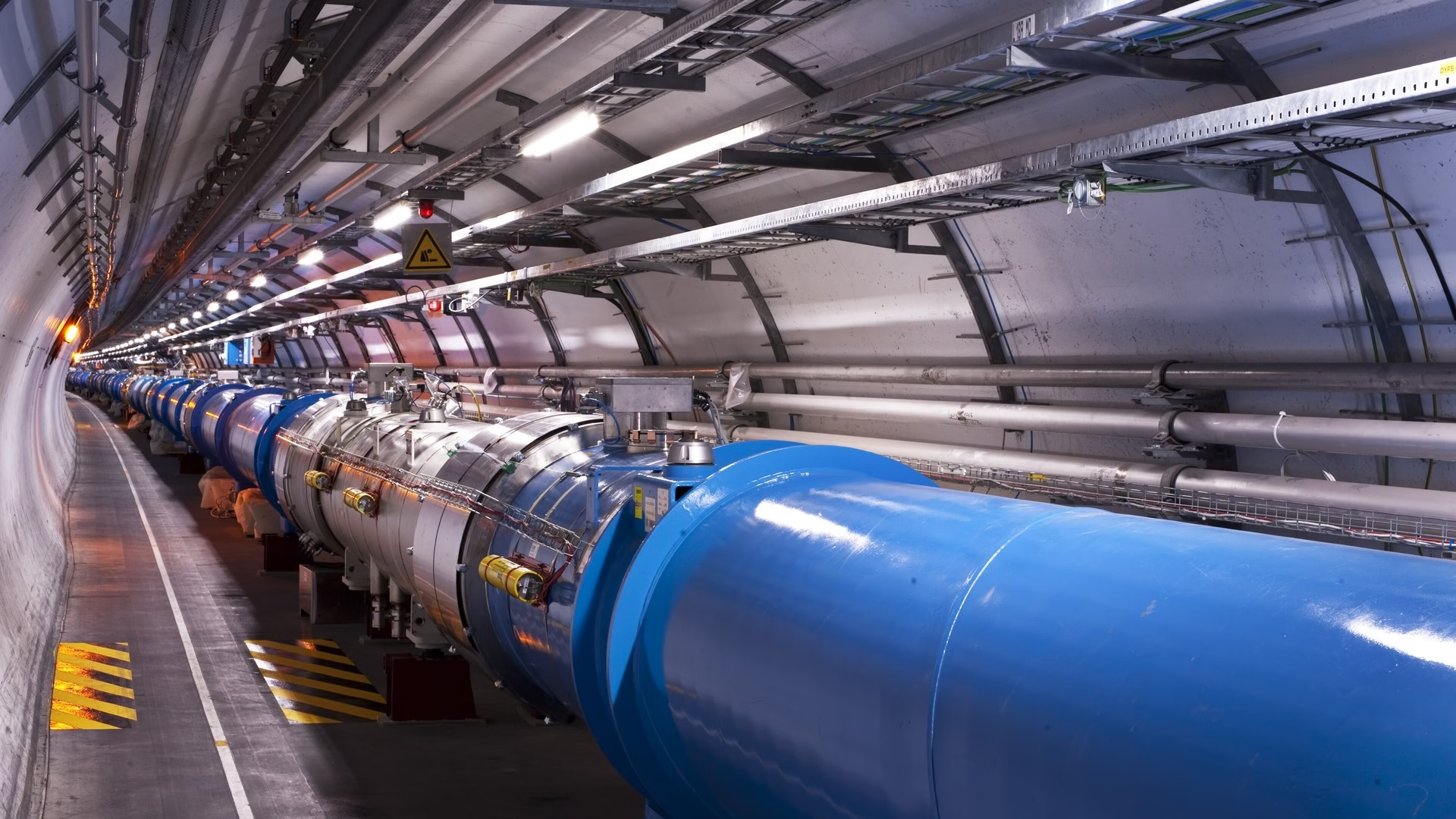
The numbers first, because they’re wild. The LHC’s main dipole magnets run at 1.9 K (−271.3°C), while the average temperature of deep space, set by the cosmic microwave background (the residual glow of the Big Bang), hovers around 2.7 K (−270.5°C). CERN’s own press office has said it plainly: for stretches of the accelerator, the machine under the Franco-Swiss border is colder than the space between stars.
The comparison makes a great headline and invites the wrong follow-up question: how do you get colder than space, and why bother? Helium liquefies at around 4.2 K at normal pressure, which is already startlingly cold and already good enough to make niobium-titanium superconducting. If you’ve read about how materials behave in the punishing environment of actual outer space, you know the cold alone is rarely the hard part of engineering at these extremes. What matters is what the fluid does at that temperature.
Almost every retelling skips this detail: between 4.2 K and 1.9 K, at exactly 2.17 K, liquid helium stops behaving like a normal liquid altogether. CERN picked 1.9 K because it needed to land just past that threshold. “Colder is better” had nothing to do with choosing 1.9 K.
Source: CERN, “For the first time the LHC reaches temperatures colder than outer space” (home.cern); CERN Courier, “The challenge of keeping cool.”
Get the next one by email
Power, cooling, chips and the rules that shape them. No spam, unsubscribe any time.
The lambda point: when ordinary helium turns into a superfluid
Cool liquid helium below 2.17 K (the “lambda point,” named for how a plot of its heat capacity spikes into a Greek-letter shape at that exact temperature) and it goes through a real phase transition. It becomes helium-II, a superfluid with essentially zero viscosity. As CERN Courier and Physics World have both detailed, this is quantum mechanics showing up at engineering scale.
Normal liquid coolants remove heat by boiling: bubbles form at a hot spot, and those bubbles then insulate the very surface they’re supposed to be cooling, right when heat needs to escape fastest. Superfluid helium-II avoids the problem. Physicists describe it as two interpenetrating fluids, a normal component that carries heat and a superfluid component that carries none. Near a hot spot the normal part flows away with the heat while the superfluid part flows in to replace it. That internal counterflow gives helium-II an effective thermal conductivity far beyond any ordinary liquid’s, and it lets temperature changes travel through the fluid as a wave, which physicists call second sound.
Why does that matter for a 27-kilometre ring of magnets? The LHC’s coils are wound from niobium-titanium superconductor, packed so densely and carrying so much current that a single localized resistive spot can snowball into a full quench before conventional cooling would notice. Superfluid helium is effectively the only coolant fast enough to wick that heat away before it cascades. It’s a little like how quantum error correction needs error rates held below a hard threshold before scale becomes an advantage instead of a liability: cross the threshold and the system stabilizes, stay above it and more hardware only adds more ways to fail.
Why the LHC must stay colder than outer space to hit 8.3 tesla
Press releases usually skip the second payoff of 1.9 K entirely. Niobium-titanium is superconducting up to roughly 9 K, so 4.2 K liquid helium would technically keep the magnets superconducting with room to spare. Pushing the operating point down to 1.9 K also raises the alloy’s critical current density, the maximum current it can carry before superconductivity breaks down.
That higher current density lets the LHC’s dipole magnets sustain 8.3-tesla bending fields, strong enough to steer proton beams around a 27-kilometre ring at just shy of light speed. Run the same coils at the “easier” 4.2 K and you lose the superfluid heat-transport regime and the current margin that makes 8.3 T achievable at all. The 2.3-kelvin gap between 4.2 K and 1.9 K does two jobs of real physics at once.
Delivering that across the whole ring is an industrial undertaking. CERN’s cryogenic plant holds roughly 36,000 tonnes of magnet cold mass at 1.9 K using about 120 tonnes of helium, cooling more than 1,000 large superconducting magnets through 40,000 leak-tight pipe seals, drawing on the order of 40 MW of electrical power. CERN itself describes that as ten times what a locomotive needs. The same logic pushes data-center operators toward deals like Equinix’s move to source nuclear power directly rather than wait in the grid queue: when your infrastructure has a non-negotiable physical requirement, you build the power supply to match it.
Source: CERN Courier, “The challenge of keeping cool”; CERN, “Cryogenics: Low temperatures, high performance” (home.cern).
⚡ PHOTON’S TAKE
I’ve stood next to CERN’s cryogenic pipework, and 1.9 kelvin is arithmetic. Miss the lambda point by a fraction and you’re back to boiling helium, with bubbles insulating the exact hot spots that trigger a quench. Superfluid helium-II doesn’t boil; it moves heat like a wave, so a phase change does the hard work for free. If you want stronger magnets, crossing a quantum threshold gets you further than adding cooling ever could.
What this means for the next collider
There’s a nice irony here. The machine engineered to recreate conditions like the trillion-kelvin quark-gluon plasma CERN’s ALICE experiment studies in lead-ion collisions also needs one of the largest and coldest cryogenic systems ever built. CERN uses a specific quantum phase transition as a tool, the same way ALICE uses extreme heat as a tool.
That matters for what comes next. The High-Luminosity LHC, being installed during the long shutdown that began in July 2026, adds niobium-tin focusing quadrupoles with peak fields of about 11.4 tesla, and they too sit in superfluid helium at 1.9 K. The baseline for the proton stage of the proposed Future Circular Collider uses 14-tesla niobium-tin dipoles at 1.9 K as well. The one route out of the superfluid regime runs through high-temperature superconductors: the 2025 feasibility study notes that such magnets could operate between 4.5 K and 20 K and cut the cryogenic power bill, if they mature in time. Until then, the temperature of the coolant is as much a design choice for the next collider as the size of its tunnel.
Cite this article
Turner, A. (2026, September 5). Why the LHC Is Colder Than Outer Space, On Purpose. ScienceShot. https://scienceshot.com/post/lhc-colder-than-outer-space
Turner, Alex. “Why the LHC Is Colder Than Outer Space, On Purpose.” ScienceShot, 5 Sept. 2026, scienceshot.com/post/lhc-colder-than-outer-space.
Turner, Alex. “Why the LHC Is Colder Than Outer Space, On Purpose.” ScienceShot, September 5, 2026. https://scienceshot.com/post/lhc-colder-than-outer-space.
@online{scienceshot-lhc-colder-than-outer-2026,
  author       = {Turner, Alex},
  title        = {{Why the LHC Is Colder Than Outer Space, On Purpose}},
  organization = {ScienceShot},
  date         = {2026-09-05},
  year         = {2026},
  url          = {https://scienceshot.com/post/lhc-colder-than-outer-space}
}
https://scienceshot.com/post/lhc-colder-than-outer-space
Get the weekly brief
Sourced analysis of data-centre engineering and regulation, every Monday. No spam, unsubscribe any time.